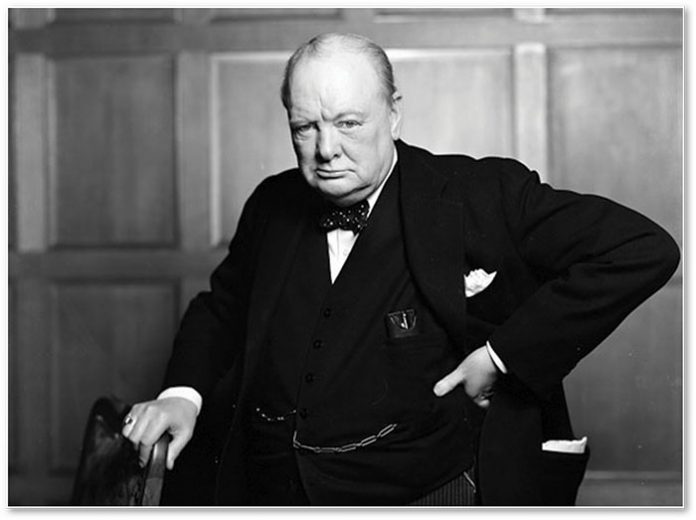
johnbowe.info – Winston Churchill remains one of the most influential and iconic figures of the 20th century. A man of great intelligence, determination, and oratory skill, Churchill’s leadership during World War II helped to steer Britain through its darkest hours and played a significant role in shaping the outcome of the war. Known for his indomitable spirit, Churchill also served in various political roles throughout his career, leaving an indelible mark on both British and global history.
This article explores the life and legacy of Winston Churchill, his career in politics, his leadership during wartime, and the lasting impact of his work on world history.
Early Life and Education
Winston Leonard Spencer Churchill was born on November 30, 1874, at Blenheim Palace, Oxfordshire, England, into an aristocratic family. His father, Lord Randolph Churchill, was a prominent Conservative politician, and his mother, Jennie Jerome, was an American socialite. Raised in an environment of privilege, Churchill’s early life was marked by a complex relationship with his family and a series of academic challenges.
A Difficult Childhood
Churchill’s early years were fraught with difficulty. He struggled in school, failing to meet his father’s expectations and being frequently punished for his perceived lack of discipline. He attended the prestigious Harrow School, but his academic performance was inconsistent. Despite this, Churchill developed a keen interest in history and literature, subjects that would later shape his political thinking.
Churchill’s relationship with his father was strained, as Lord Randolph was an ambitious figure who hoped his son would follow in his political footsteps. However, Winston’s academic struggles led to his father’s disappointment, and they grew increasingly distant. Nevertheless, Winston was determined to carve his own path.
The Royal Military Academy and Early Career
Churchill’s desire for a military career led him to the Royal Military Academy Sandhurst, where he trained to become an officer in the British Army. After graduating in 1894, he was commissioned as a second lieutenant in the 4th Queen’s Own Hussars. Churchill’s early military career was marked by bravery and a thirst for adventure, as he participated in campaigns in India, Sudan, and South Africa.
It was during the Second Boer War in South Africa (1899-1902) that Churchill first gained significant public attention. As a war correspondent for the Morning Post, he was captured by the Boers and held as a prisoner of war. His daring escape and return to Britain made headlines, and it was here that Churchill began to cultivate his public persona as a man of courage and resolve.
Political Career and Early Leadership
Entry into Politics
Churchill entered politics in 1900 when he was elected as a Member of Parliament (MP) for Oldham, a constituency in northern England. Initially, he was a member of the Conservative Party, following in his father’s footsteps. However, his political beliefs evolved over time, and he soon became disillusioned with the party’s stance on various issues, including social reform and the treatment of workers.
In 1904, Churchill made the dramatic decision to leave the Conservative Party and join the Liberal Party, where he could more effectively advocate for progressive reforms. This move was controversial, but it marked the beginning of a new chapter in his political career. Over the years, Churchill became known for his fierce advocacy for social welfare programs, including unemployment insurance and the expansion of the welfare state.
Ministerial Roles
Throughout his early political career, Churchill held several important ministerial positions. He served as the President of the Board of Trade from 1908 to 1910, where he championed social reforms such as the introduction of labor laws and the expansion of worker protections. His tenure in this role solidified his reputation as a reformer and a champion of the working class.
Churchill later served as the Home Secretary (1910-1911) and First Lord of the Admiralty (1911-1915), where he gained further prominence for his military and naval leadership during World War I. As First Lord of the Admiralty, Churchill played a critical role in modernizing the Royal Navy and preparing Britain for the growing tensions in Europe.
The Gallipoli Campaign and Controversy
One of the defining moments of Churchill’s early career came during World War I, when he was one of the architects of the Gallipoli Campaign (1915). The operation, which aimed to open a new front by attacking the Ottoman Empire, ended in failure. The disastrous campaign led to significant losses and undermined Churchill’s standing within the government. He was blamed for the failure, and he resigned from his post as First Lord of the Admiralty.
Despite this setback, Churchill’s resilience remained evident. He returned to the frontlines, serving in the British Army on the Western Front. His determination to restore his reputation and prove his leadership abilities would eventually pay off.
Churchill’s Leadership During World War II
The Rise to Prime Minister
In the late 1930s, as Europe edged closer to the outbreak of war, Churchill’s warnings about the rising threat of Nazi Germany were increasingly ignored by British political leaders, including Prime Minister Neville Chamberlain. However, with the growing threat of Adolf Hitler and the invasion of Poland in 1939, Chamberlain’s leadership faltered. In 1940, with the situation growing more dire, Winston Churchill was appointed Prime Minister.
This marked the beginning of Churchill’s most defining period as a leader. His leadership during World War II would be characterized by his unwavering resolve, powerful speeches, and ability to rally the British public during the darkest days of the war.
The Battle of Britain
In 1940, after Germany had invaded France and other parts of Europe, Britain stood alone against the Nazi regime. Churchill’s most famous speeches during this period came as he inspired the British people to stand firm against the Luftwaffe’s aerial bombardment. The Battle of Britain, which lasted from July to October 1940, saw British forces successfully defend against German air raids. Churchill’s leadership throughout this period, particularly his defiant rhetoric, strengthened the resolve of the British people.
In his now-iconic speech delivered in August 1940, he declared, “Never in the field of human conflict was so much owed by so many to so few,” referring to the Royal Air Force pilots who fought off the German attacks.
The United States and the Atlantic Charter
One of Churchill’s key achievements during World War II was forging a close relationship with U.S. President Franklin D. Roosevelt. Though initially neutral in the war, the United States began to provide significant aid to Britain through programs like the Lend-Lease Act. In August 1941, Churchill and Roosevelt met aboard a ship in the Atlantic Ocean to sign the Atlantic Charter, a statement of principles that laid the groundwork for the post-war world order and the formation of the United Nations.
Churchill’s diplomacy and strong partnership with Roosevelt helped secure vital support for Britain, both militarily and economically, throughout the war.
The D-Day Invasion and Victory
In 1944, the Allies launched the D-Day invasion of Normandy, a pivotal moment in the war that marked the beginning of the end for Nazi Germany. Churchill, along with Roosevelt and other Allied leaders, played a critical role in planning the operation. The successful invasion, combined with the collapse of the German war machine, brought about the eventual Allied victory in Europe.
Churchill’s leadership throughout the war, particularly during times of extreme adversity, earned him a lasting place in history as a wartime hero.
Post-War Period and Legacy
The Election Loss and Return to Power
After the war, Churchill’s popularity was at an all-time high, but in the 1945 general election, the Labour Party led by Clement Attlee won a sweeping victory. Churchill was defeated, and the Labour government took office. However, Churchill remained a significant figure in British politics, and in 1951, he returned to power as Prime Minister once again.
During his second term, Churchill’s health began to decline, and his influence in the government gradually diminished. However, his legacy as a wartime leader and his role in shaping the post-war world continued to define his political career.
Posthumous Recognition and the Churchill Legacy
Winston Churchill passed away on January 24, 1965, at the age of 90. His death marked the end of an era in British politics, but his legacy lives on. Churchill is remembered as one of the greatest wartime leaders in history, a man whose leadership was crucial in the defeat of Nazi Germany and the preservation of democracy in Europe.
Churchill’s legacy extends beyond his wartime leadership. His speeches, his writings, and his influence on global diplomacy have left an indelible mark on history. In 1963, he was awarded the Nobel Prize in Literature for his historical writings, which include his multi-volume work on World War II and his history of the English-speaking peoples.
Conclusion
Winston Churchill’s life was one of remarkable achievements, personal resilience, and enduring influence. As a statesman, a writer, and a wartime leader, he played a pivotal role in shaping the course of history during the 20th century. His leadership during World War II, his defiance in the face of adversity, and his eloquent speeches continue to inspire generations. Churchill’s legacy remains firmly entrenched in the annals of history as a symbol of courage, conviction, and dedication to the ideals of freedom and democracy.